


Quaker buildings in Newham
9th September 2026
A walk with Gregory Moffatt
Event date: 4 September 2026 | Author/byline: Georgina Philippou
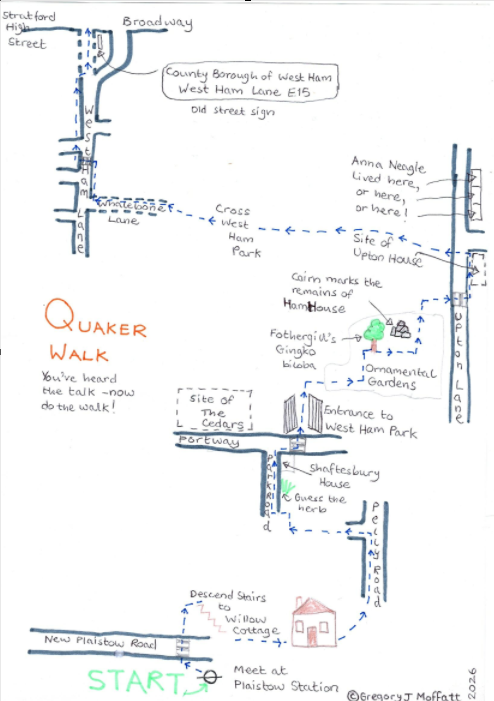
On 4 September 2026 a group of intrepid Newham u3a explorers set off from Plaistow station just as the rain had stopped for the day with our knowledgeable* and energetic guide Gregory. Our mission was to explore Newham's Quaker heritage through its buildings. And it turns out there is a deep Quaker heritage in our borough, with illustrious names such as Pelly, Gurney, Fry and Fothergill popping up in the names of blocks of flats, housing estates, and street names. But alas, not a blue plaque to be seen.
One of the highlights of the day came within seconds: the impossibly (and improbably) picturesque Willow Lodge, formerly the gatehouse of the Willows estate and which belonged to the first-born son of Mr John Henry Pelly, a businessman and a governor of the Bank of England no less from 1841 to 1842.
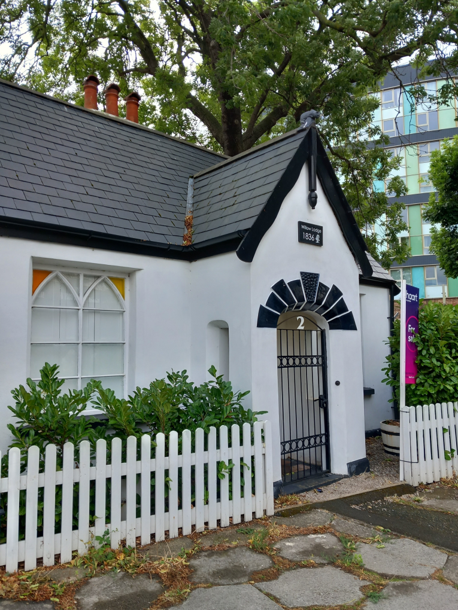
Willow Lodge, dated 1836.
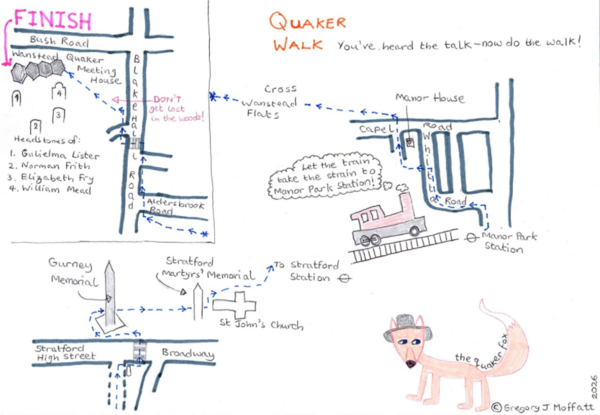
From there, off to the beautiful West Ham Park aka the Kew Gardens of the East, on land owned and occupied (was it Ham House or Upton House, the name changes over time, but a huge cairn marks the spot) by Samuel Gurney. Mr Gurney was a banker (another one) and an anti-slavery activist and opponent of capital punishment. There is a memorial to Mr Gurney, erected by his friends in 1861, just outside the entrance to the old Stratford Shopping Centre - look for Cleopatra's needle...
On the way to the park, we encountered Shaftesbury House, named for Anthony Ashley Cooper, the 7th Earl of Shaftesbury, and a noted philantropist and social reformer.
Rather appropriately, this is opposite what was The Cedars, home of Elizabeth Fry (nee Gurney and sister of the aforementioned Samuel). Mrs Fry was a prison reformer and advocate of women's issues, among other things. Rather inappropriately perhaps the site is now a Territorial Army training centre.
In West Ham Park we paused to admire the ornamental gardens, and the display of information about Dr John Fothergill, an eighteenth-century physician and botanist. The ornamental gardens are the remains of his botanical garden and well worth a visit (at least one local didn't even know it was there and was "stunned", although she was able to continue the walk). The planting is amazing, and you can see the Gingko tree that Fothergill planted, now believed to be the second oldest in the UK (after the one at Kew).
Just outside the park is Joseph Lister Court, a 1960s block on what was Dr Lister's home, yes, he of the invention of antiseptic surgery was also a Quaker, and yes, we knocked down his home. Confusingly, this was called Upton House.
Then it was back across West Ham Park, down Whalebone and West Ham Lanes to The Broadway, where we saw the Gurney Memorial obelisk and the memorial to the Stratford Martyrs, before walking to Stratford Station.
A couple of stops on the Elizabeth (a different Elizabeth) line later, Elizabeth Fry's son, William, lived at the Manor House in Manor Park from about 1810. This is an imposing white building in the middle of a residential estate and is now part Housing Association homes, part Coop Funerals (the whole thing was a Coop Dairy from 1925) and part care home.
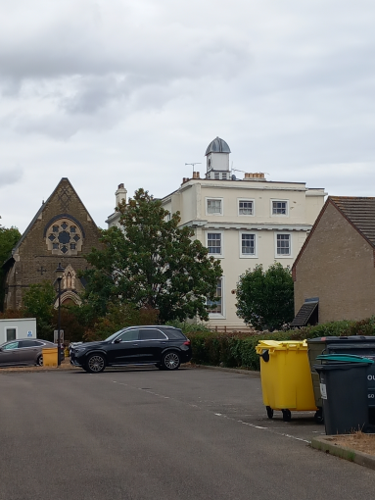
The Manor House in Manor Park.
A tramp across Wanstead Flats and a corner of Epping Forest brought us to our ultimate destination: the Quaker Meeting House in Wanstead. After a day of history we weren't expecting a cool, low-slung 1968 architect-designed pavilion. It was designed by Norman Frith, a lecturer in architecture at North East London Poly (as was) and himself a Quaker. His building replaced the original 1870 meeting house (built on dubious claims to the forest land, it seems). There is a cemetery at the back which has headstones (but not necessarily remains - it's complicated) to Norman Frith and Elizabeth Fry and Joseph Lister's niece Gulielma (who founded the British Mycological Society and knew a lot about slime moulds).
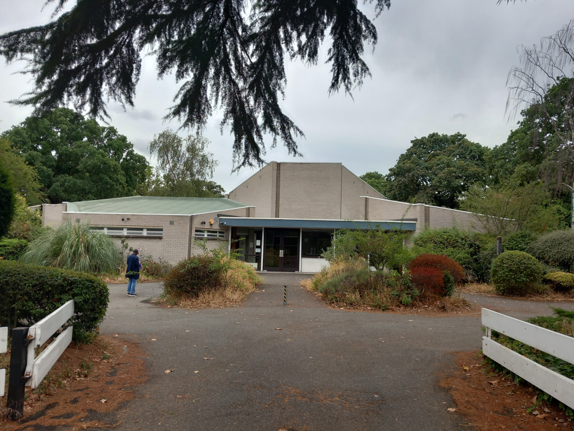
Wanstead Quaker Meeting House.
It seems there was no end to the achievements of the Quakers of Newham. By the time we had ended our walk, and each wended our way home, we had achieved 20,000 steps.
*This walk was inspired by our u3a monthly talk in April 2026, given by Dr Mark Gorman and Mr Peter Williams, who provided much of the information imparted on the walk.

Comments
Leave a comment